Growth Framework for Engineering Success
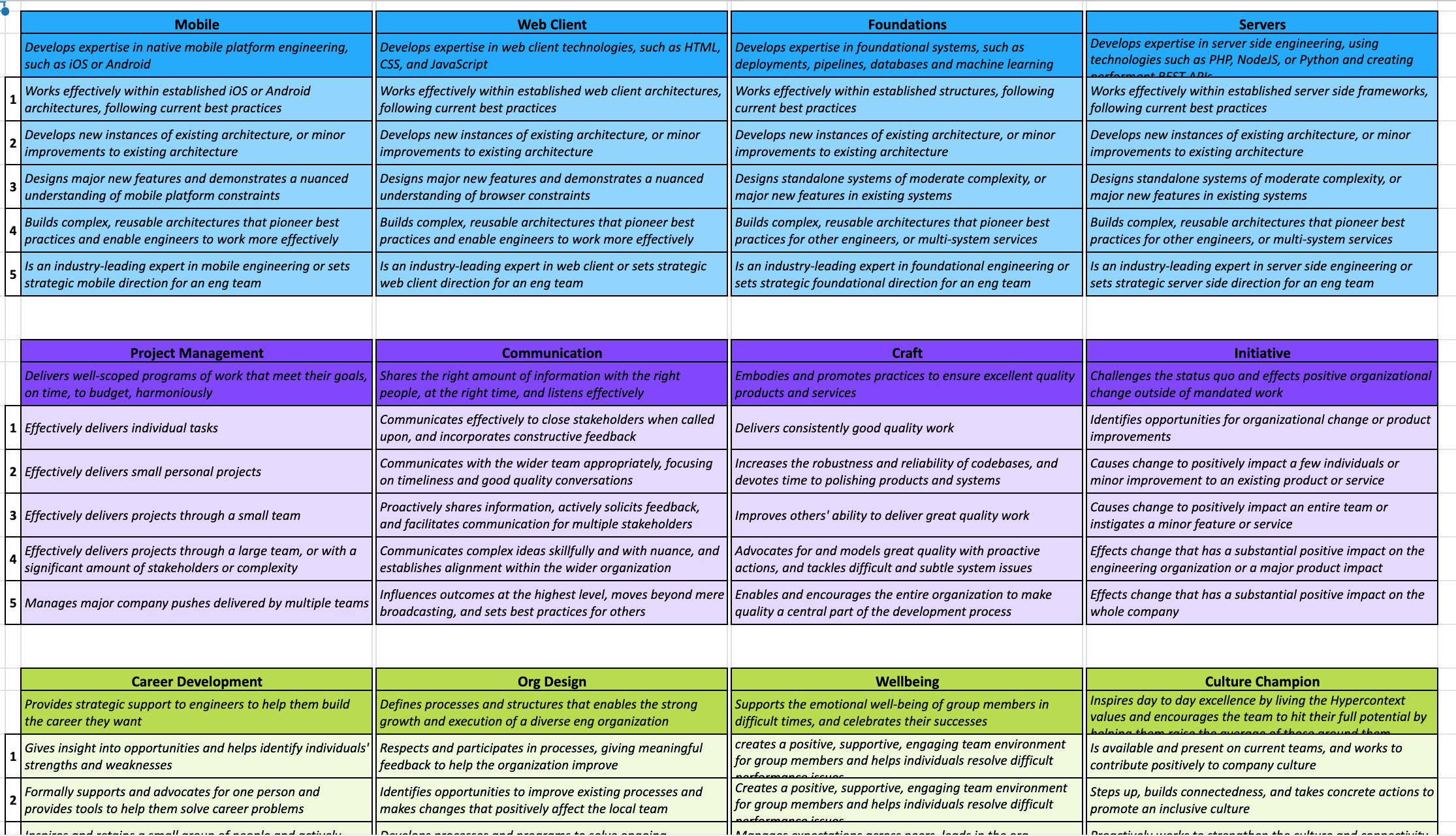
Career ladders have a familiar failure mode: they describe one archetype of engineer, and everyone who doesn't match it either fakes it or stalls. The deep specialist gets told to "work on visibility." The glue person who makes the whole team faster has nothing on the rubric that names what they do.
At Hypercontext we replaced our ladder with a growth framework built around milestones instead of titles. Here's how it works — and at the bottom, the actual documents and tooling so you can steal it wholesale.
The shape of it
Sixteen tracks in four categories: building (technical craft), executing (shipping), supporting (mentoring, hiring, evangelism), and strengthening (making the org better). Each track has five milestones, progressively harder, each with real examples of what it looks like in practice. That last part matters: "Level 3 in Architecture" means nothing, but "designed the service boundary that let two squads ship independently" is something you can point at.
Points, not vibes
Milestones earn points, and a milestone replaces the points of the one before it — so you can't grind level-1 milestones everywhere and call it growth. Your level and compensation band derive from total points. Two things fall out:
- There's more than one way to be senior. A deep specialist and a broad multiplier can land at the same level through completely different tracks.
- The compensation conversation gets boring, in a good way. Levels come from points, points from milestones, milestones from evidence. The raise stops going to whoever argued best.
The conversation is the product
The rubric isn't the point — the conversations it forces are. Monthly growth check-ins used the framework as the shared map: here's where you are, here's the milestone you're reaching for, here's what evidence looks like. Nothing about a review was ever a surprise, and the high-stakes annual conversation mostly disappeared.
And because any system of judgment gets things wrong, there's a formal appeals process: a structured way to lay out evidence and get an assessment reconsidered, instead of a hallway argument.
Steal it
- Define the tracks and milestones that fit your org — ours are a starting point, not gospel.
- Write real examples into every milestone. This is the slow part and the part that makes it work.
- Stand up the snowflake app (below) so people can see their shape across tracks.
- Put a monthly growth conversation on the calendar.
- Derive levels from points, and write down the appeals process before anyone needs it.
There's also a product management adaptation.
The documents and tools
Growth Framework (.docx)
Principles, the 16 tracks, and how milestones, points, and levels fit together.
Engineering Growth Rubric (.xlsx)
Every milestone across all 16 tracks, with descriptions and examples.
Download Engineering Growth Rubric
Story of You (.docx)
The narrative template: where someone has grown, the evidence, and where to aim next.
Growth Framework Appeal Template (.docx)
The structured appeal: what's contested, the evidence, the milestones in question.
Download Growth Framework Appeal Template
Snowflake Growth App
The visualization tool — originally built by Medium, adapted for our framework. It draws each person's milestone shape across the tracks, which turns an abstract rubric into something you can discuss in a 1:1.
Snowflake Growth App GitHub Repo
git clone https://github.com/Hypercontext/snowflake
cd snowflake
npm install -g yarn   # if you don't have yarn
yarn && yarn dev      # dev server; `yarn export` builds to out/